A new study led by CHEEC researchers has found that exposure to neonicotinoid insecticides — the most widely used class of insecticides worldwide — is nearly universal among pregnant women and farmers in eastern Iowa. The findings also demonstrate that conventional biomonitoring approaches that track only parent pesticide compounds significantly underestimate actual human exposure.
Published in Environmental Science and Pollution Research, the study describes a new analytical method developed at CHEEC capable of simultaneously measuring 21 neonicotinoids and their metabolites in human urine — one of the most comprehensive panels reported to date. The method includes seven key metabolites and transformation products not measured in prior biomonitoring studies, including breakdown products of clothianidin, imidacloprid, and thiamethoxam. It was designed as a companion to a previously published environmental water method, enabling researchers to directly link environmental contamination to human exposure.
Key Findings
- Neonicotinoids were detected in 99% of pregnant women (n=246) and 100% of farmers (n=47) tested in eastern Iowa, with 18 different compounds identified across both populations.
- Imidacloprid metabolites were stronger predictors of total neonicotinoid body burden than parent compounds alone (rs = 0.735 vs < 0.6 for parents), indicating that parent-only monitoring substantially underestimates true exposure.
- Some metabolites were found at higher concentrations in pregnant women than in farmers, despite farmers having greater overall exposure — suggesting that exposure pathways and metabolic processing differ between the two groups.
- Total neonicotinoid concentrations in pregnant women showed a significant increasing trend from 2010 to 2025, driven by a growing number and diversity of compounds detected rather than higher concentrations of any single pesticide.
- The median number of neonicotinoids detected per sample rose from 4.5 in 2010–2011 to 6 in 2024–2025.
Why Metabolites Matter
Most existing biomonitoring methods focus on parent neonicotinoid compounds and exclude metabolites — the breakdown products created as the body processes these chemicals. However, some neonicotinoid metabolites have stronger binding affinity for mammalian receptors and may exhibit greater toxicity than their parent compounds. This study found that imidacloprid metabolites, including imidacloprid-olefin and 5-hydroxy-imidacloprid, were more strongly correlated with total neonicotinoid burden than any parent compound measured. This means that biomonitoring programs relying solely on parent compounds are missing a significant portion of the exposure picture — a gap that is particularly important for vulnerable populations such as pregnant women.
Exposure Trends Over 15 Years
Using anonymized samples from 246 pregnant women collected through the University of Iowa Perinatal Family Tissue Bank between 2010 and 2025, the study documented a statistically significant upward trend in total neonicotinoid concentrations. Median concentrations approximately tripled over the study period. Notably, this increase was not driven by the dominant compounds — imidacloprid and clothianidin levels remained relatively stable — but rather by rising contributions from thiamethoxam, acetamiprid-N-desmethyl, flupyradifurone, and sulfoxaflor, along with an increasing number of compounds detected per sample.
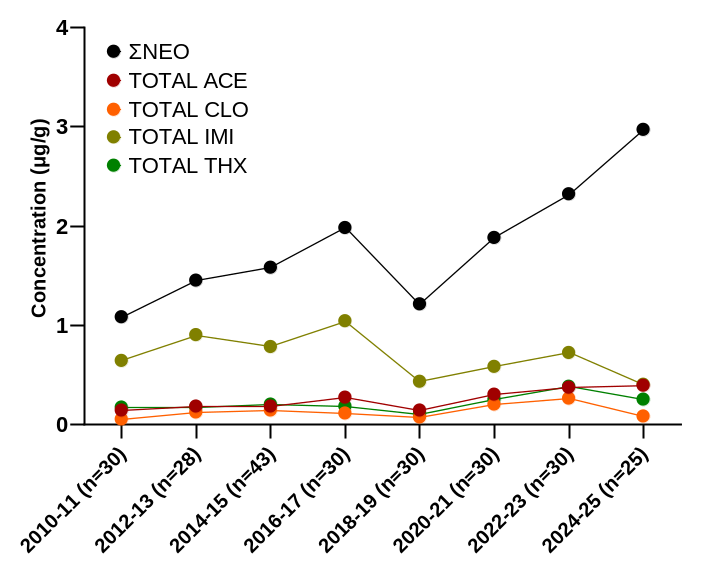
Figure 3. Median concentrations (μg/g) of neonicotinoids in pregnant women in Iowa from 2010 to 2025. Click here to view the full article.
Comparing Farmers and Pregnant Women
To validate the new method, the research team re-analyzed stored samples from a prior CHEEC study of 47 Iowa farmers. While farmers showed higher overall neonicotinoid levels as expected from their occupational exposure, the metabolite patterns differed in unexpected ways. Some metabolites appeared at higher concentrations in pregnant women, suggesting distinct exposure sources and metabolic responses between the two populations. These differences underscore the importance of including metabolites in future exposure assessments, particularly for populations where dietary and environmental pathways may predominate over occupational exposure.
"These findings make clear that monitoring only parent neonicotinoid compounds substantially underestimates internal exposure. This is especially important for vulnerable populations like pregnant women, where metabolite patterns may reveal exposure risks that conventional methods miss entirely."
— Darrin A. Thompson, MPH, Ph.D., CHEEC Associate Director and Corresponding Author
A New Tool for Public-Health Research
The validated laboratory method demonstrated high sensitivity, accuracy, and reliability, making it suitable for large-scale biomonitoring and long-term studies. By measuring both parent compounds and metabolites in a single analysis, the approach offers researchers a more complete way to assess exposure and potential health risks.
The LC–MS/MS method achieved limits of detection ranging from 0.005 to 0.14 ng/mL and limits of quantification from 0.017 to 0.46 ng/mL across all 21 analytes. A key aspect of the validation was the comparison of method performance between synthetic urine and pooled human urine, which revealed that pooled urine — with its complex endogenous matrix — produced substantially greater ion suppression. The authors emphasize that method validation using real human urine is essential for ensuring reliable results in population-based biomonitoring studies.
"Iowans are rightly concerned about how the environment impacts their health, and a first step in addressing these concerns is developing new methods to fill in existing data gaps related to exposure. This method gives public-health researchers a powerful new tool. It allows us to better connect environmental contamination, human exposure, and downstream health research."
— David M. Cwiertny, Ph.D., CHEEC Director, Professor of Civil and Environmental Engineering, and Co-Author
Funding
This work was supported by the University of Iowa's Center for Health Effects of Environmental Contamination with funding from the State of Iowa and the Iowa Department of Natural Resources; the University of Iowa's Heartland Center for Occupational Health and Safety; the University of Nebraska Medical Center's Central States Center for Agricultural Safety and Health through the National Institute for Occupational Safety and Health (NIOSH); the NIEHS-funded Environmental Health Sciences Research Center; and the National Center for Advancing Translational Sciences.
Full Citation
Xi, W., Onysio, S., Rhodes, M.C., Faudel, A.J., Flunker, J.C., Santillan, M.K., Santillan, D.A., Cwiertny, D.M., & Thompson, D.A. (2026). Development and validation of matrix-validated LC–MS/MS method for simultaneous quantification of 21 neonicotinoids and their metabolites in human urine. Environmental Science and Pollution Research. https://doi.org/10.1007/s11356-026-37779-9